Rebar Estimator
How to estimate rebar quantity — and why the offcut is a remainder, not a percentage
← Back to the calculator- The estimating sequence
- The offcut is a remainder, not a percentage
- What a 20 ft stock bar wastes
- Worked example: same job, three stock lengths
- The offcut is only waste if nothing fits in it
- Rebar takeoff: the count before the order
- How to read a rebar schedule
- What this page does not count
- Watch: 6.7% vs 30%
- Common questions
- What this page does not do
The step estimators get wrong is the third. The offcut is not a percentage — it is the remainder left on each stock bar after the pieces are cut. On the same 20 ft stock it runs from 0% on a 10 ft line to 40% on a 12 ft line.
A 7 ft line is the clearest case: 30% waste from 20 ft bars, 12.5% from 40 ft bars. Same steel, same job, different bar length. Work it out below.
If what you need first is the quantity rather than the ordering — how many bars, feet and pounds a pour takes — the how much rebar do I need page has a table by project type, on the same #4 at 12 in basis.
The estimating sequence
Four steps, in this order. Each one changes the number the next one works on, so getting them out of order is how an estimate goes wrong.
- Takeoff — the net length of steel in the finished work. For a rectangular grid this is the bar count each way multiplied by the line lengths. The method is on calculate rebar for a slab.
- Laps — every line longer than one stock bar needs a joint, and every joint costs a lap length of extra steel. This is steel you install, so it is not optional and not waste. Same page, same table.
- Offcut — what is left over on each bar after the pieces are cut. This is steel you buy and never place. It is the subject of this page.
- Round up to whole bars — then convert to weight and cost. Rebar weight calculator has the conversion.
The offcut is a remainder, not a percentage
Most estimating advice says to add a waste factor. The trouble is that there is no such factor: the waste is decided by arithmetic, and the arithmetic has only two inputs — your line length and the length of bar you buy.
Everything else follows from those four lines. Two jobs with identical steel can have wildly different waste, purely because of how the line length divides into the bar.
What a 20 ft stock bar wastes
Every row below is the same bar, cut to a different line length. This is why a flat waste percentage cannot be right.
| Line length | Pieces per 20 ft bar | Offcut per bar | Offcut % |
|---|---|---|---|
| 4 ft | 5 | 0 ft | 0% |
| 5 ft | 4 | 0 ft | 0% |
| 6 ft | 3 | 2 ft | 10% |
| 7 ft | 2 | 6 ft | 30% |
| 8 ft | 2 | 4 ft | 20% |
| 9 ft | 2 | 2 ft | 10% |
| 10 ft | 2 | 0 ft | 0% |
| 12 ft | 1 | 8 ft | 40% |
| 16 ft | 1 | 4 ft | 20% |
| 18 ft | 1 | 2 ft | 10% |
| 20 ft | 1 | 0 ft | 0% |
Swipe the table sideways for more columns →
Nothing in that table is a rule of thumb — it is division. Change the stock length and every row changes.
Worked example: same job, three stock lengths
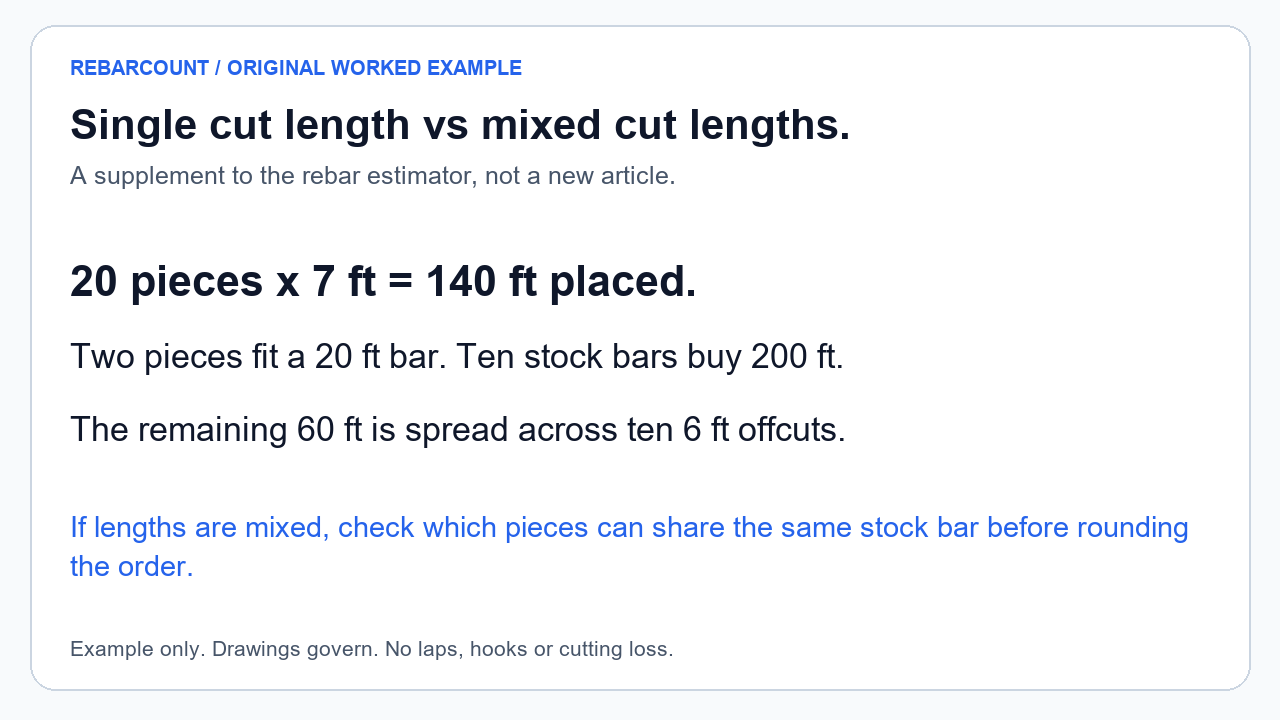
Twenty lines, each 7 ft long. That is 140 ft of steel to place, whichever bar you buy.
| Stock bar | Pieces per bar | Bars to buy | Length bought | Offcut | Waste |
|---|---|---|---|---|---|
| 20 ft | 2 | 10 | 200 ft | 60 ft | 30.0% |
| 30 ft | 4 | 5 | 150 ft | 10 ft | 6.7% |
| 40 ft | 5 | 4 | 160 ft | 20 ft | 12.5% |
Swipe the table sideways for more columns →
Three answers between 6.7% and 30% for the same 140 ft of steel. Note that the longest bar is not automatically the best: 30 ft wins here because 7 ft divides into it more cleanly, not because it is bigger. Ask the yard which lengths it actually stocks, then run all of them. For the stock lengths themselves — what comes 20 ft and 40 ft in the US, 12 m and 6 m in metric countries, and what a bar of each size weighs — see how long are rebar bars.
The offcut is only waste if nothing fits in it
An offcut is a piece of bar, not scrap. On the 20 ft example above each bar leaves 6 ft — and if the same job also has a 6 ft trim line, that offcut is the trim line, and the waste drops to zero without buying anything extra.
This is the part a percentage never captures. Before you accept a waste figure, look down the whole takeoff for short lines that will fit in the leftovers. It is the cheapest saving on any estimate, because it costs nothing but attention.
Rebar takeoff: the count before the order
A takeoff is the job counted line by line: every distinct cut, how many pieces, how long, and the total feet and pounds that adds up to. The arithmetic on this page starts from a takeoff, because the offcut is the remainder of a division — and the division needs the pieces listed first.
A takeoff table has five columns: line, pieces, length of each, total length, weight. Worked in #4 bar at 0.668 lb/ft:
| Line | Pieces | Each | Total length | Weight |
|---|---|---|---|---|
| 7 ft trim lines | 20 | 7 ft | 140 ft | 93.5 lb |
| 6 ft edge lines | 12 | 6 ft | 72 ft | 48.1 lb |
| 8 ft mat bars | 4 | 8 ft | 32 ft | 21.4 lb |
| Total | 36 | — | 244 ft | 163.0 lb |
Swipe the table sideways for more columns →
244 ft of #4 is 163.0 lb of steel in the work. The order weight is a different number: 244 ft needs 13 twenty-foot bars, which is 260 ft bought, so 16 ft of offcut rides along — 6.2% on this division. Ten of the 7 ft lines leave a 6 ft offcut each, so the twelve 6 ft edge lines fit inside those left-overs without buying anything extra.
Two habits make a takeoff checkable. Add the pieces column and the total-length column separately — if the two disagree, the table is wrong, not the steel. And run every short line down the whole table before ordering, because an offcut that becomes a line is the cheapest saving on the job.
A takeoff is a quantity, not a quote. It does not price the bar, and it does not include chairs, tie wire, bends or site loss (the same exclusions as the rest of this page). If what you have is the other direction — spacing and dimensions, bars to count — the slab page works the grid first and the cuts second.
How to read a rebar schedule
A rebar schedule (the bar bending schedule on a set of drawings) is a takeoff someone else has already done — the same line-type table, with drawing marks attached. Reading one is five columns and one multiplication per row:
- Mark — the label the drawing uses (M101, S2, ...) pointing at that row.
- Size — the bar designation, #4 or #5. This is what carries the weight per foot.
- Shape — the bending shape code. 00 is a straight bar; other codes carry hooks or bends, and a longer cut length than the straight-line dimension.
- Length of each — the cut length of one piece, hooks included.
- No. — how many pieces the drawing calls for.
Total length is “length of each × number”, and weight is “total length × weight per foot”. A three-row schedule, worked through:
| Mark | Size | Shape | Each | No. | Total | Weight |
|---|---|---|---|---|---|---|
| M101 | #4 | 00 straight | 19 ft | 20 | 380 ft | 253.8 lb |
| M102 | #4 | 00 straight | 19 ft | 20 | 380 ft | 253.8 lb |
| M201 | #5 | 55 U-bent | 8 ft | 12 | 96 ft | 100.1 lb |
| — | — | — | — | 52 | 856 ft | 607.8 lb |
Swipe the table sideways for more columns →
One size carries this job: the two #4 marks are 760 of the 856 ft, so the order is two #4 sizes of question and one small #5 line. Before ordering from a schedule, check two things: whether length of each already includes the hook allowance (if it does not, bent bars come up short when the fab shop adds it), and that every mark on the drawings points at a row (a mark with no schedule row is the most common gap). Then apply the stock-length arithmetic above — the schedule tells you what to place, not what to buy.
What this page does not count
- The width of the cut. Bar is sheared, not sawn, and the loss is a fraction of an inch per piece — it disappears inside the rounding to whole bars. If your cuts are abrasive-sawed, add a small allowance per cut.
- Bends and hooks. A hooked bar has a longer cut length than its straight-line dimension. Standard practice is to add the hook allowance to the piece length before you work out pieces per bar — do that first, then run the arithmetic above.
- Tying wire, chairs and spacers. Real costs on a job, but they are bought by weight or by count, not by bar length, so they are outside this calculation.
- Site loss. Damaged, cut short, or walked off. That is a risk allowance on top of the offcut, not part of it, and it is a commercial decision rather than an arithmetic one.
Watch: 140 ft, three stock lengths, three offcuts
Common questions
How much waste should I add to a rebar estimate?
Work it out rather than adding a flat percentage. The offcut is what is left of each stock bar after the pieces are cut, so it depends on how your line length divides into the bar you buy. On 20 ft stock the same job wastes nothing on a 10 ft line, 10% on a 6 ft line and 30% on a 7 ft line. Count pieces per bar, take the remainder, then compare stock lengths before you order.
What is a good waste factor for rebar?
A flat percentage is the usual shortcut and the arithmetic shows why it is unreliable. On 20 ft stock a 4 ft line wastes nothing, a 7 ft line wastes 30% and a 12 ft line wastes 40%. The factor that decides your waste is how the line length divides into the stock length, not a number taken from a table.
How do I reduce rebar waste?
Change the stock length you buy, not the design. A 7 ft line wastes 30% of a 20 ft bar and 12.5% of a 40 ft bar, because 40 ft divides into five 7 ft pieces with 5 ft left over. Ask the yard which lengths it stocks and run the remainder for each. Where the same job has a short line, a long offcut can become a piece instead of scrap.
Is a lap the same as waste?
No. A lap is steel you install. It is a real part of the finished slab, so it belongs in the order. Offcut is steel you buy and never place. Both make the order bigger, but only the offcut is waste.
What is a rebar takeoff?
A takeoff is the written count of a job line by line: each cut, how many pieces, how long, and the total feet and pounds that adds up to. It is the quantity the yard needs, before waste, stock length or price is applied. On a #4 job the takeoff weight is total length times 0.668 lb per foot — 244 ft of line is 163.0 lb of steel to place.
How do I read a rebar schedule?
Read it as a line-type takeoff: the mark points at the row on the drawing, size and shape tell you the bar, length of each times number gives total length, and total length times weight per foot gives the weight. Check that every drawing mark has a row before you order, and that the length of each already includes the hook allowance.
What this page does not do
Related
- Rebar calculator — bar counts, laps, lengths, weight and cost from your dimensions
- Calculate rebar for a slab — the grid takeoff and the lap allowance, worked to a 49-bar order
- Rebar weight calculator — weight per foot, per bar and per order, and the split between slab steel, laps and offcut
- Rebar size & weight chart — every imperial and metric size, with areas and bars per ton